







What does it mean when a child goes to bed hungry in a world that produces more than enough food?
In Africa today hunger is not an idea. It is the cry of an infant whose mother has no strength to nurse. It is the silence of a classroom where children are too tired to learn. It is the hours lost when girls walk miles for water instead of holding a book. It is the small hands of a boy bent in labor because hunger has emptied his home.
The figures are stark. In 2024, more than 307 million Africans were chronically undernourished, more than one fifth of the continent. Nearly 30 percent of children under five are stunted, their bodies and minds slowed by lack of nutrition. In Central Africa the figure rises above 37 percent. Malnutrition is a factor in almost 45 percent of deaths in children under five. Diseases that should not kill, such as pneumonia, diarrhea, and malaria, become fatal when a child is too weak to fight. Hunger also robs education. In some regions children lose a third of their school hours to illness, fatigue, or the search for water.

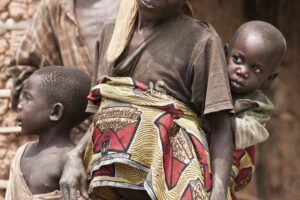
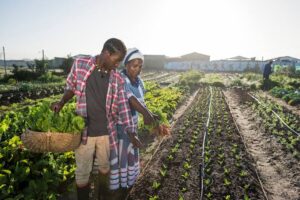
Photo attribution: Food for Africa News contributor: Ibraham Lukenge
Is this fate, or is it choice?
Food aid saves lives. It is essential in a crisis. But charity alone cannot build the future. Long term security comes only when governments act. It comes from policies that open markets, from investments that reach the farmer, from clean water that reaches the household, from school programs that guarantee a meal. Feeding a child is not charity. It is governance.
The voices of hunger are easy to overlook, yet they are everywhere. A child who comes to school without breakfast struggles to stay awake through the lesson. A teacher watches pupils drop out because their families cannot afford both food and school fees. In the village, boys and girls trade study hours for field work or water collection because the family needs their labor to survive. These are not abstract reports. They are daily realities, written on the faces of children.
The scale is vast. Across Sub-Saharan Africa, an estimated 86 million children are engaged in child labor, many in agriculture, working because their families cannot meet the cost of food. UNICEF reports that nearly one in three children under five in Africa is stunted, their growth impaired by poor diets. In West Africa, up to 40 percent of children arrive at school without a morning meal, and hunger is one of the leading causes of absenteeism and early dropout. The World Food Programme warns that hungry children lose not only calories but hours of education each week.

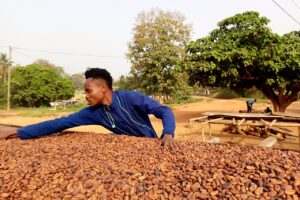
Photo attribution: DEGAN Gabin, CC BY-SA 4.0 https://creativecommons.org/licenses/by-sa/4.0, via Wikimedia Commons
The cost of hunger is measured in more than calories. It is seen in children leaving classrooms, in years of education lost, in lives cut short too soon.
There are examples that show change is possible. Ghana’s School Feeding Programme, launched in 2005, now reaches more than a million children and buys much of its food from local farmers. In Malawi, the Targeted Input Programme of the early 2000s supplied smallholders with subsidized fertilizer and seed, turning shortages into grain surpluses in several years. In Rwanda, the National Strategy for Child Development and Nutrition has helped cut stunting rates through investments in health services and community nutrition programs.
Hunger is not only about food. It is about how a nation values its children. A society cannot be strong if its children are weak.
So the question must be asked again, in every parliament, in every cabinet, in every home: if roads can be built, if armies can be trained, if markets can be opened, why can one plate of food not be placed before every child?
That is not charity. That is the measure of governance.
Sources
- WHO, UNICEF, FAO, IFAD, WFP. The State of Food Security and Nutrition in the World 2025. July 2025.
Hunger in Africa rising, 307 million undernourished.
https://www.who.int/news/item/28-07-2025-global-hunger-declines-but-rises-in-africa-and-western-asia-un-report - FAO. Regional Overview of Food Security and Nutrition in Africa 2023.
342 million facing severe food insecurity in 2022, 282 million undernourished.
https://openknowledge.fao.org/items/0db03746-74e1-4b78-9508-70b9f661859c - UNICEF Data. Child Malnutrition.
Nearly 30 percent of children under five in Africa stunted, Central Africa above 37 percent.
https://data.unicef.org/topic/nutrition/malnutrition/ - WHO Regional Office for Africa. Child Health.
Malnutrition as underlying cause in 45 percent of child deaths under five.
https://www.afro.who.int/health-topics/child-health - ILO (International Labour Organization). Child Labour: Global Estimates 2020, Trends and the Road Forward.
86 million children in Sub-Saharan Africa engaged in child labour, most in agriculture.
https://www.ilo.org/global/publications/books/WCMS_797515/lang–en/index.htm - World Food Programme (WFP). School Meals Programme.
Hunger one of the leading causes of absenteeism, school meals as solution.
https://www.wfp.org/school-meals - WFP Regional Bureau for Western Africa. Hunger and Education in West Africa.
Up to 40 percent of children in West Africa attend school without a morning meal.
https://www.wfp.org/countries/west-and-central-africa - Government of Ghana, Ministry of Gender, Children and Social Protection. Ghana School Feeding Programme (GSFP).
Over one million children reached, food sourced from local farmers.
https://gsfp.gov.gh/ - Dorward, A., Chirwa, E. The Malawi Agricultural Input Subsidy Programme, 2005–2016.
Targeted Input Programme and later reforms that turned shortages into surpluses.
https://www.sciencedirect.com/science/article/pii/S0306919217301077 - Republic of Rwanda, Ministry of Health. National Strategy for Child Development and Nutrition (2013–2018).
Programs contributing to reduction in stunting rates.
https://www.moh.gov.rw/


You are doing good work thank you for sharing.
100%