







Food for Africa News sat down with Dr. Shepard Ndlela, a research scientist at the International Centre of Insect Physiology and Ecology (icipe), to discuss Africa’s fight against locusts and the role of the neem tree. In the conversation, Dr. Ndlela explained how neem, already rooted in African soil, can provide farmers with a safe and affordable tool in pest management while reducing dependence on imported chemicals.
For as long as farmers have worked the land in Africa, they have dreaded the arrival of locusts. These insects, harmless when alone, become a moving wall of destruction when they swarm. Crops vanish, grain stores empty, and hunger spreads quickly.
The Food and Agriculture Organization estimates that a swarm covering one square kilometer can consume as much food as 35,000 people eat in a single day. In East Africa’s 2020 outbreak, locusts spread across 10 countries and destroyed harvests that could have fed 25 million people. Earlier waves in the 1940s and 1950s forced governments to pour tens of millions into chemical spraying campaigns, often leaving poisoned soil behind.

Photo attribution: Iwoelbern, CC BY-SA 3.0 https://creativecommons.org/licenses/by-sa/3.0, via Wikimedia Commons
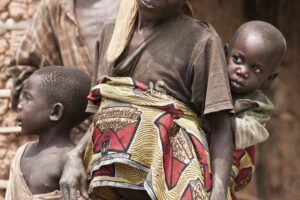
The destruction is never only about fields. Malnutrition follows, leaving children weak and vulnerable against disease. During the 1986–1989 plague across 23 countries, more than one in five children in some rural communities in Chad and Sudan were found to be acutely malnourished. In 2020, the United Nations warned that child malnutrition in parts of Kenya, Ethiopia, and Somalia would rise by 15 percent in areas hit by swarms.

DFID – UK Department for International Development, CC BY 2.0 https://creativecommons.org/licenses/by/2.0, via Wikimedia Commons
Amid these crises, scientists continue to explore more sustainable defenses. One option already growing in Africa’s fields is the neem tree, Azadirachta indica. Its seeds contain compounds that disrupt insect feeding and breeding, offering farmers a natural line of protection.
“Neem doesn’t kill instantly,” says Dr. Ndlela of icipe. “It interferes with growth, reproduction, and feeding. This makes it useful against certain pests such as aphids, caterpillars, and tomato leaf miners.” He notes, however, that in the case of fast-moving locust swarms capable of stripping crops within hours, neem’s slow mode of action is a limitation. It can reduce population growth and act preventively, but it is not a stand-alone emergency solution.

Photo attribution: Scovia Williams, CC BY-SA 4.0 https://creativecommons.org/licenses/by-sa/4.0, via Wikimedia Commons
Unlike imported pesticides, neem leaves no toxic residue. It is safe for people, livestock, and pollinators, and it breaks down naturally in soil and water. Farmers can harvest neem seeds, press them for oil, and apply the product to their crops, cutting costs and reducing dependence on foreign chemicals.
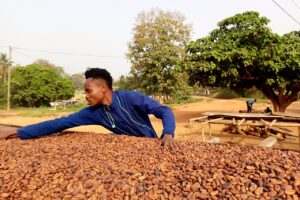
Ground neem seeds mixed with water can be used as a biopesticide. However, most of the bioactive components in neem do not dissolve easily in water. The key ingredient, Azadirachtin, is concentrated in the oil of the seed, which means proper extraction is needed for full strength. Some years ago, icipe scientists worked with farmers in Kilifi, on the Kenyan coast, where the community harvested neem seeds, crushed them, mixed them with water, and applied them to cabbages. The approach showed promise but ended before machines could be introduced to extract the oil more effectively. While there are costs tied to extraction equipment, this can also be seen as an opening for value addition and local enterprise. With support, farmers could organize into groups and create small cottage industries, turning neem oil production into both a pest control solution and a source of income.
The cost of fighting swarms with chemicals is staggering. During the 2020 outbreak, more than 200 million dollars went into aircraft, fuel, and imported sprays. These had to be repeated again and again as new swarms formed. Neem can be produced at a fraction of that cost if processing and training are in place. “When neem seeds are collected and pressed within the community, the cost per hectare is far lower than synthetic pesticides,” Dr. Ndlela explains. “But this requires scale, proper processing, and farmer training.”
The limits are real. Neem works more slowly than chemicals. Farmers who expect immediate knockdown sometimes assume it has failed. Poorly processed neem products lose strength within days, and strong sunlight can break down the active compounds. “That is one of the challenges,” says Dr. Ndlela. “Neem requires knowledge. It requires patience.” icipe and its partners are now developing more stable formulations that can be stored and applied consistently, even in harsh climates.

Photo attribution: icipe
The case for alternatives becomes sharper when set against Africa’s long history with locusts. One of the most haunting episodes came in 1989, when Chad was already weakened by drought, hunger, and political unrest. Then the locusts came. Alfred M. Rivas, a lead entomologist for the State Department in Washington DC at the time, was called to Chad to direct the emergency response. He recalled the terror of those days: “Locusts would swarm in like a dark cloud in the sky, and then just descend directly onto the crops,” Rivas said. “Within hours, everything green was gone.” For farming families, it was devastation piled upon desperation. Rivas died in 2002, but his words remain a reminder of why lasting solutions are needed.
For Dr. Ndlela, neem is not a silver bullet, but it represents a shift in thinking. It offers protection without poisoning the soil or water. It spares bees and other pollinators. It gives farmers the chance to defend their fields without falling deeper into debt for imported sprays. It even brings side benefits: neem trees provide shade, improve soil, and give farmers seed and oil they can sell.
The dangers of chemical dependence are not small. Each year, thousands of African farmers and sprayers suffer burns, illness, and even death from misuse of strong pesticides. The World Health Organization estimates millions worldwide suffer acute pesticide poisoning. Neem avoids many of these risks. It is not only cheaper but safer, when used appropriately.
ICIPE is also broadening the fight. Its researchers are testing pheromones that disrupt insect swarming and breeding. They are developing fungi to target cattle ticks and basil extracts to repel fruit flies. They are working on biological larvicides to block mosquitoes before they spread malaria. Together with neem, these measures point toward a future where Africa uses its own biodiversity as defense rather than leaning on foreign chemicals.

Photo attribution: icipe
“The solution lies not only in producing more food but in producing it sustainably, equitably, and resiliently,” says Dr. Ndlela. “Neem is part of Africa’s broader shift toward ecological and locally driven innovation.”
The history of locusts has been one of destruction. Chemicals have given quick results but no lasting security. Neem and other ecological methods will not replace fast-acting responses in an emergency, but they can reduce dependence on harmful sprays and strengthen resilience over time. The trees are already rooted in Africa’s soil. The science is in Africa’s hands. What remains is the will and the scale to act.
Anyone who wants to learn more can contact press@foodforafrica.news.
Sources
Exclusive interview with Dr. Shepard Ndlela, International Centre of Insect Physiology and Ecology (icipe), for Food for Africa News
https://www.icipe.org/
Food and Agriculture Organization of the United Nations, Locust crisis response
https://www.fao.org/ag/locusts
National Research Council, Neem: A Tree for Solving Global Problems
https://nap.nationalacademies.org/catalog/1924/neem-a-tree-for-solving-global-problems
United Nations Environment Programme, Alternatives to synthetic pesticides
https://www.unep.org/resources
USAID, Locust and Grasshopper Control in Africa, Environmental Assessment, 1989
https://nwrcarchive.libraryhost.com/archival_objects/a2b67e15926fbc6806a89e3ce2f526e6
United Nations OCHA / ICPAC, From Crisis to Innovation: Learning from the Previous Desert Locust Invasions (2021)
https://www.icpac.net/news/from-crisis-to-innovation-learning-from-the-previous-desert-locust-invasions/
FAO, Desert Locust Technical Series No. 27: Economics of Desert Locust Management
https://openknowledge.fao.org/bitstreams/8db9adfa-de06-4e2f-912b-941c799af0a3/download
World Health Organization, Pesticide Poisoning: Global Estimates and Public Health Impact
https://apps.who.int/iris/handle/10665/362007

I would like to hear more about biological larvicides to block mosquitoes
Yes please. Me too
Good article. How can I get more information on growing neem?
I think neem has good use but maybe not the magic fix people hope for. It works slow, not fast like chemicals, so it cannot stop a big swarm when it already come. But for small pests in the farm it is safe, local, and better for health. I like that scientists are studying what Africa already has in the soil, not just buying outside. Maybe the answer is neem together with other tools, not neem alone.
Interesting read about neem and locusts. I was more curious when you mention mosquito and cattle tick. Can you share more on that part? How strong is neem really for those, and is it being tested anywhere in Africa? I think many farmers would like to know if it can help with animals and health, not only crops.
Very interesting and informative read. Thank you. I would like to know if any farmers are planting neem trees and are able to harvest the seeds yet. I believe the neem oil can also be used as a mosquito repellent.
Also biological larvicides to block mosquitoes is a very interesting approach. I would be interested in learning more on that subject.
Thank you FFA News and your contributors.
are there ways to get neem seeds to plant i am a farmer in kumasi and are there a program to help farmers in ghana