











For years Africa was discussed as a place of aid and crisis. Today the conversation in trading houses, ministries, and investment banks sounds very different.
Africa is now widely viewed as one of the world’s most important commodity regions. From cocoa and coffee to copper, oil, lithium, and rare minerals used in batteries, the continent sits at the center of several global supply chains. Investors are expanding ports, railways, and logistics networks. Governments are negotiating export corridors. Commodity traders are opening new offices across the region.
In short, Africa is increasingly seen as a strategic supplier to the global economy.
Yet behind the surge of interest lies a question African policymakers are asking with increasing urgency.
What does the commodity boom mean for Africans themselves?
Across the continent, raw materials dominate exports. A recent report from the United Nations Conference on Trade and Development found that 46 of Africa’s 54 countries depend heavily on commodities such as agricultural goods, oil, or minerals for the majority of their export earnings.
Commodity trade is not a minor part of these economies. In many countries it is the economy.
Oil revenues fund national budgets. Cocoa supports millions of farmers in West Africa. Copper mines employ entire towns in Central Africa. Cashews, coffee, tea, cotton, and gold all flow through global markets from African soil.
But the structure of that trade tells a deeper story.
Much of what leaves Africa does so in raw form. Minerals are shipped abroad for refining. Agricultural crops are exported before they are processed or branded. Manufacturing, packaging, and marketing frequently happen elsewhere.
That matters because the largest profits in global commodities are rarely made at the farm or the mine. They are made further along the chain.
Take cocoa. West Africa produces roughly two-thirds of the world’s supply, yet the chocolate industry worth billions of dollars is largely based in Europe and North America. Farmers who grow the beans often earn only a small fraction of the final retail value.
The same pattern repeats across sectors. Coffee grown in East Africa is roasted overseas. Minerals mined in Central Africa are refined in Asia. Cotton harvested in the Sahel is spun and manufactured abroad.
For African economies, this structure produces a difficult paradox.
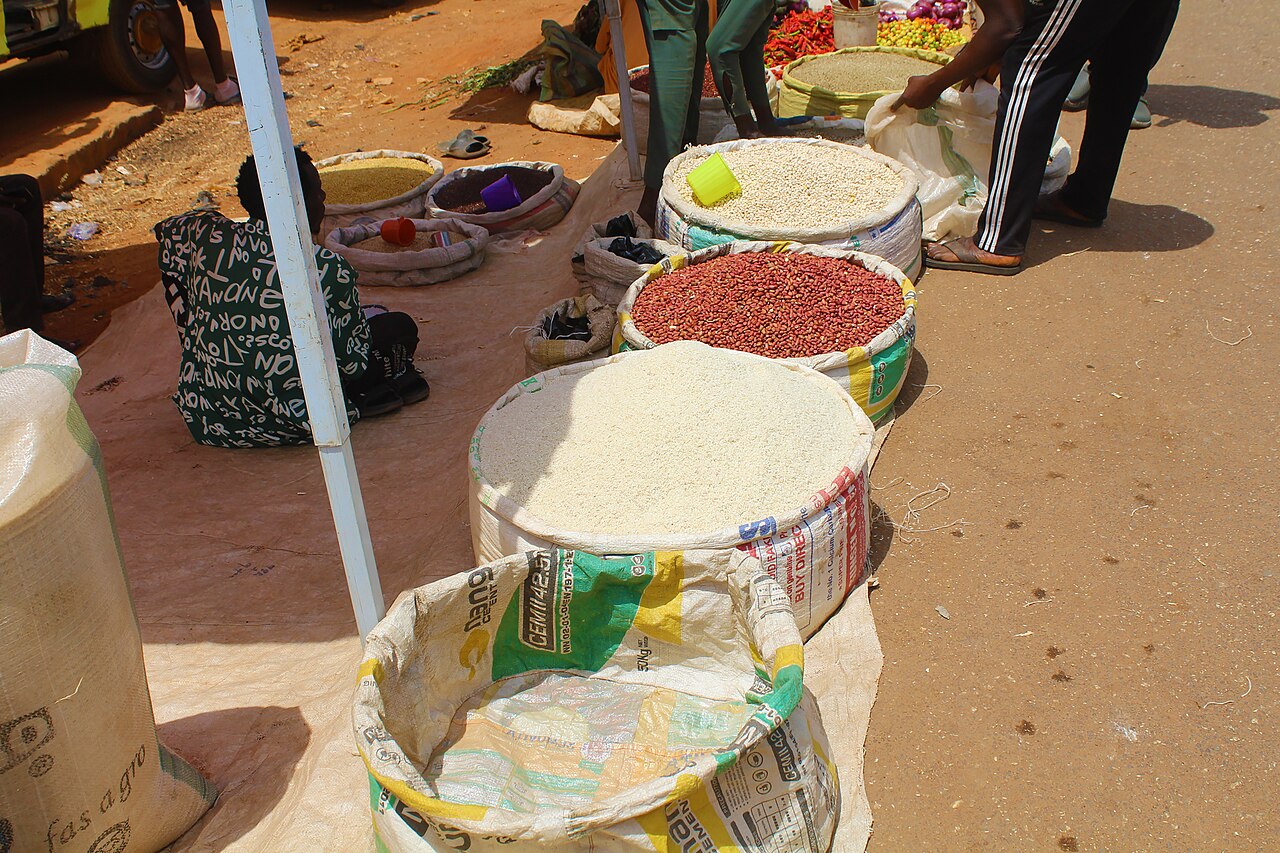
The continent exports enormous quantities of agricultural goods and natural resources, yet it still imports large amounts of food. In 2023 alone, Africa imported roughly $75 billion worth of food products, including wheat, dairy, and rice.
In some cases the contradiction is striking. Countries that export agricultural commodities may still face rising food prices at home, especially when global markets fluctuate or currencies weaken.
Part of the explanation lies in how trade networks developed. Historically, infrastructure across much of Africa was designed to move raw materials from interior regions to ports for export. Railways and highways often link mines or plantations directly to shipping terminals.
Moving commodities outward can be easier than distributing food between neighboring regions.
Price volatility adds another layer of uncertainty. Commodity markets rise and fall quickly. When prices surge, government revenues increase and farmers may expand production. When prices fall, incomes can drop just as quickly.
For economies heavily dependent on a single export crop or mineral, those swings can ripple through entire societies.
None of this means commodity trade is a problem in itself. On the contrary, the continent’s resource wealth is one of its greatest economic advantages. Global demand for energy, metals, and food is expected to keep rising for decades.
What matters is where the value is created.
Increasingly, economists and policymakers across Africa are arguing that the next stage of development must focus on capturing more of the commodity value chain locally. Processing crops, refining minerals, expanding regional trade, and strengthening domestic food systems are frequently cited as priorities.
The stakes are significant.
Africa’s population is projected to grow rapidly in the coming decades, and its economic influence in global trade is likely to expand with it. If commodity exports remain primarily raw materials, much of the wealth generated by that trade will continue to accumulate elsewhere.
If value creation moves closer to where those resources originate, the impact could reshape both African economies and global supply chains.
The world’s traders have already recognized Africa’s importance.
The question now is whether the structure of global commodity trade will evolve enough for the continent’s resource boom to translate into widespread prosperity at home.
Main photo credit: Kambai Akau, CC BY-SA 4.0 https://creativecommons.org/licenses/by-sa/4.0, via Wikimedia Commons