






Broken credit systems, poor storage, and climate shocks show why Africa’s farming struggle is more about systems than scarcity. Yet programs from Rwanda to Zanzibar prove that with the right support, farmers can turn loss into growth.
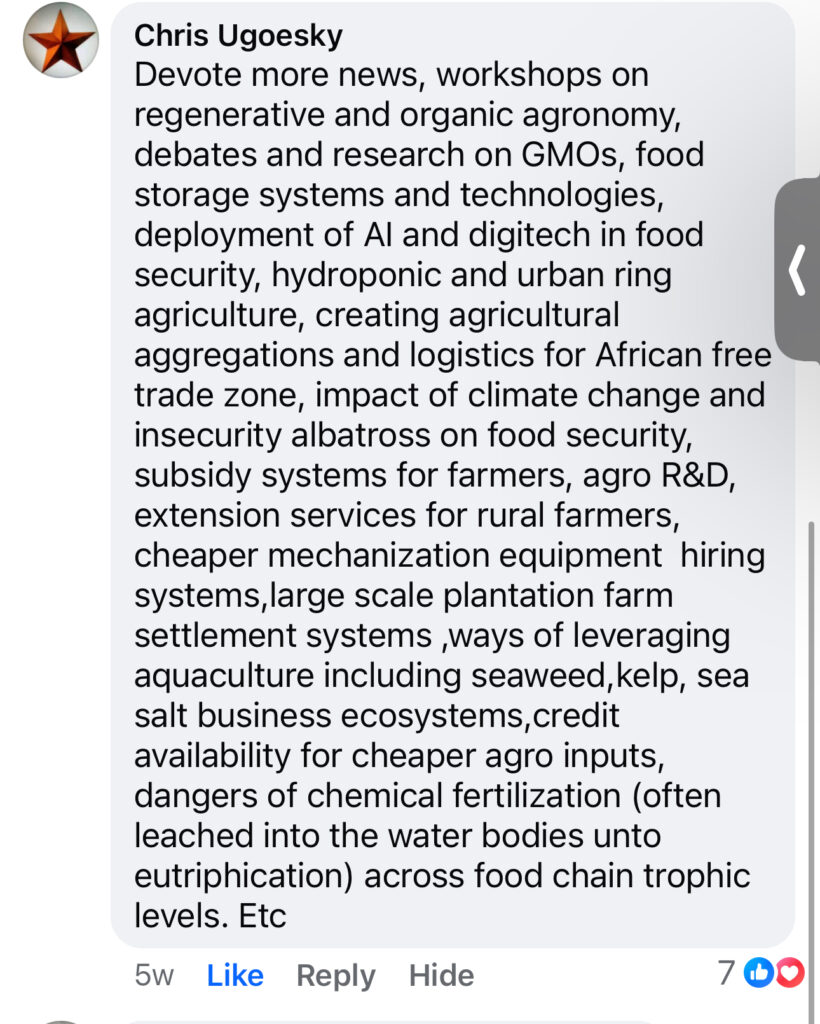
At Food for Africa News we listen closely to our readers. Many of our stories are sparked by the voices of farmers, families, and experts who write to us. This article was prepared by reader request, inspired by a comment from Chris U., who urged us to devote more reporting to regenerative farming, storage systems, subsidies, aquaculture, and the wider structures that shape Africa’s food future. His words reflect the growing call for solutions beyond emergency aid.
Hunger in Africa is not just about empty plates. It is also the result of broken credit systems that block farmers from loans, poor storage that wastes harvests, and climate shocks that destroy fields. However, all hope is not lost. There is proof that with the right support farmers can turn loss into growth.
Farmers warn that quick chemical fixes are spilling into water and wearing down soils. Around Lake Victoria, researchers report phosphorus saturation and recurring algal blooms fed by runoff from fields on the Kenyan, Ugandan, and Tanzanian shores. In Nigeria, field studies document fertilizer-driven nutrient loads in rivers and aquifers, echoing a wider review that links agrochemical runoff to degraded water quality. Against that, there are working alternatives. In Rwanda, a government initiative has trained village-level compost producers and set up soil testing and certification so farmers can buy verified compost. In Kenya’s Western region, a new project is turning rice and sugarcane residues into organic fertilizers through pyrolysis and insect composting. In Ethiopia, biofertilizer inoculants paired with balanced nutrients are raising bean yields, while compost and biochar improve acidic soils in the highlands.
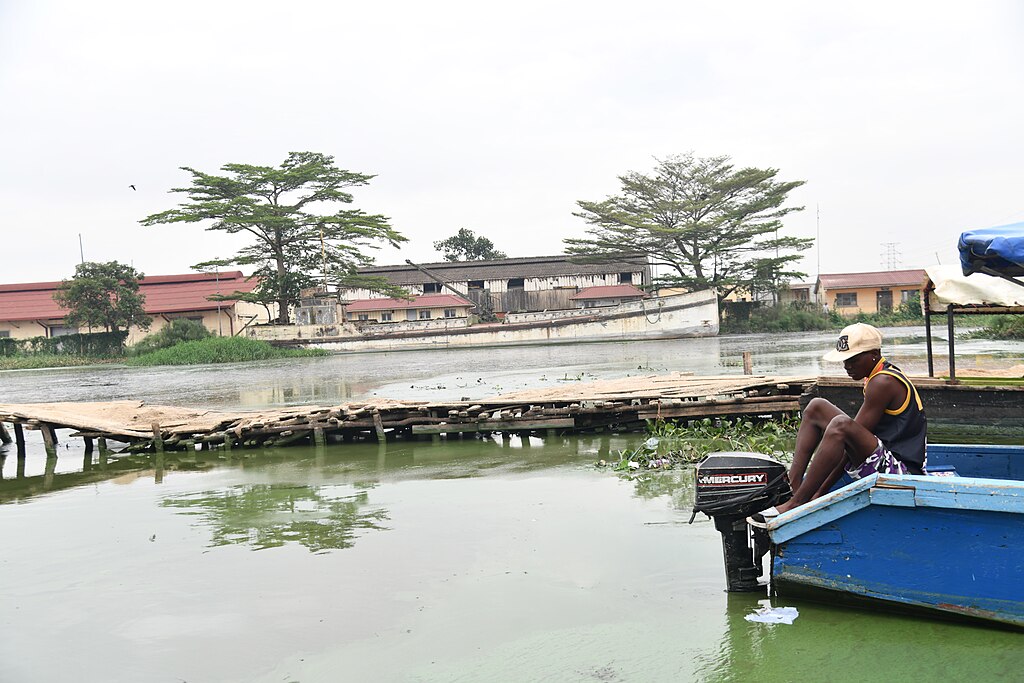
A seasonal green layer that appears on lake Victoria, locally called Mubiru, Lake Victoria photo credit: Ssemmanda will, CC BY-SA 4.0 https://creativecommons.org/licenses/by-sa/4.0, via Wikimedia Commons
Food loss is another story that rarely makes the front page. The FAO reports that one third of the world’s food is lost or wasted each year, equal to 1.3 billion tonnes. In Africa the numbers are worse, with 30 to 50 percent of food never reaching the market. The World Bank estimates that 37 percent of food in sub-Saharan Africa disappears between production and consumption. Grain losses in Eastern and Southern Africa alone cost 1.6 billion dollars each year. In a region where one in five goes hungry, these losses are devastating.
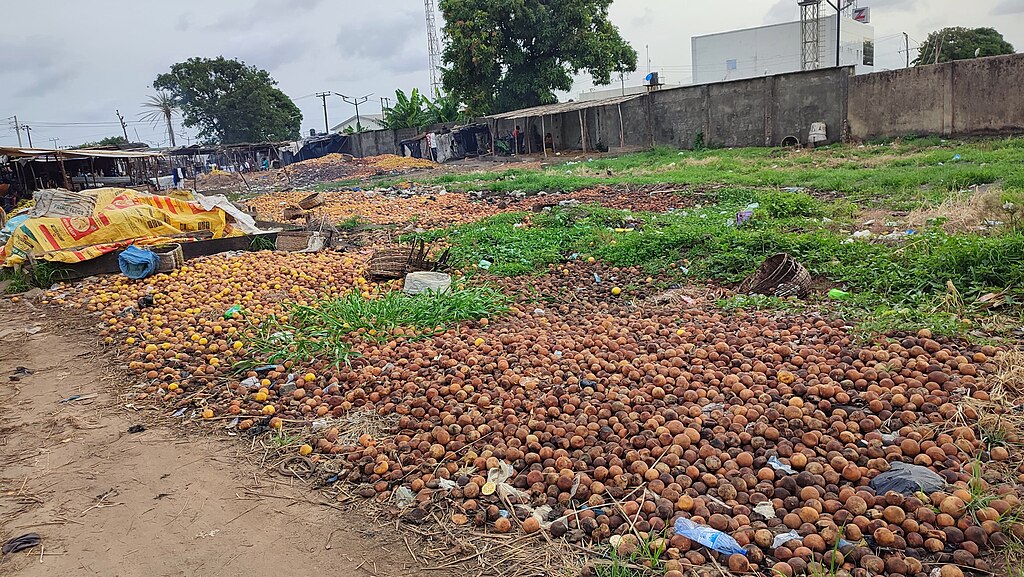
Fruit market in Iya-Iba of Lagos state where fruit sellers litter their environment with spoilt goods, Photo attribution: Bibiire1, CC BY-SA 4.0 https://creativecommons.org/licenses/by-sa/4.0, via Wikimedia Commons
Cities are growing at unmatched speed. By 2035 the continent will have six megacities of more than ten million people: Lagos, Kinshasa, Cairo, Dar es Salaam, Luanda, and Greater Johannesburg. Nairobi legalized urban farming in 2015, and factsheets now estimate tens of thousands of households grow food inside the city. In Greater Cairo, rooftop projects with greenhouses supply dense districts. Cape Town counts dozens of active community gardens on the Cape Flats and several thousand small or micro urban farmers. Urban farming is moving from experiment to necessity.
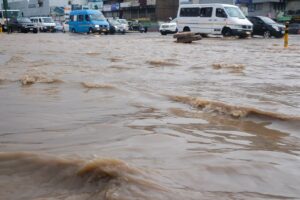
Floods in Central and West Africa have been severe. In 2024 about 7.5 million people were affected across 18 countries, with Chad and the Democratic Republic of the Congo among the hardest hit. In the DRC, the government declared a hydrological catastrophe after the worst flooding in decades left tens of thousands in shelters. Drought and long dry spells press the Sahel and the Horn. Regional food security analyses projected 49 to 55 million people in West and Central Africa in crisis or worse during the 2024 lean season. Across the Horn, 42 million people faced acute food insecurity in 2025.
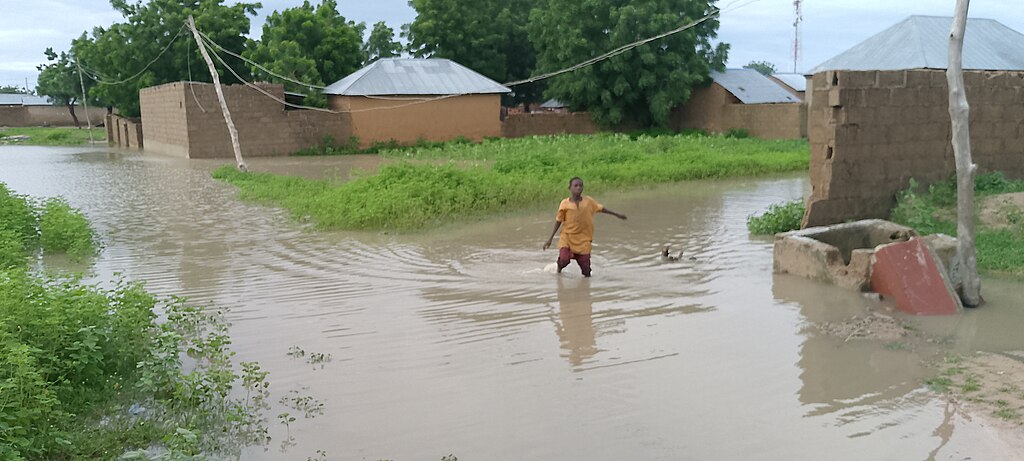
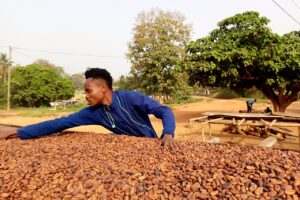
Photo credit: Muktee1494, CC0
Pests take their share. Fall armyworm cut maize yields in Ghana by an average of 26 percent and in Zambia by 35 percent during outbreaks, with FAO putting continent-wide losses near 9.4 billion dollars. For many farmers, the battle is against insects as much as weather. Aquaculture is a clear area of progress. On Zanzibar, seaweed farming employs around 25,000 people, mostly women, and new investments are shifting production from raw exports to processed products that keep more income at home.
Finance is the barrier most farmers name. In Ghana, the average lending rate hovered near thirty percent through 2024 and into 2025. In Kenya, agricultural SMEs faced loan rates near eighteen percent, and most smallholders lacked collateral. Nigeria’s lending rates climbed above twenty percent in 2024, and banks continued to treat farming as high risk. Some countries are moving to fix this. Ghana’s Planting for Food and Jobs Phase II links credit to buyers so repayment can be taken from sales, with hundreds of thousands already supplied with seed and fertilizer. Rwanda’s agriculture insurance scheme now covers more than 160,000 crop farmers each year with government-subsidized premiums. Kenya’s Warehouse Receipt System lets farmers store maize and use receipts as collateral, avoiding distress sales at harvest.
Post-harvest waste is now seeing cheaper fixes. Hermetic PICS bags are used widely across West and Central Africa, holding cowpea and grains without chemicals. More than 1.7 million bags were sold in the first five years, cutting storage losses and letting farmers wait for better prices.
There are positive lessons here. Rwanda’s insurance scheme shows how a public subsidy can make climate cover affordable. Ghana’s PFJ 2.0 gives farmers a way to access inputs without crippling bank loans. Kenya’s warehouse system helps smallholders capture value at the right time. Nairobi’s legal framework gives households the right to farm in the city. On the coast, Zanzibar’s seaweed sector shows how women-led farming can anchor a local economy. These cases show that when resources reach farmers, change is measurable.
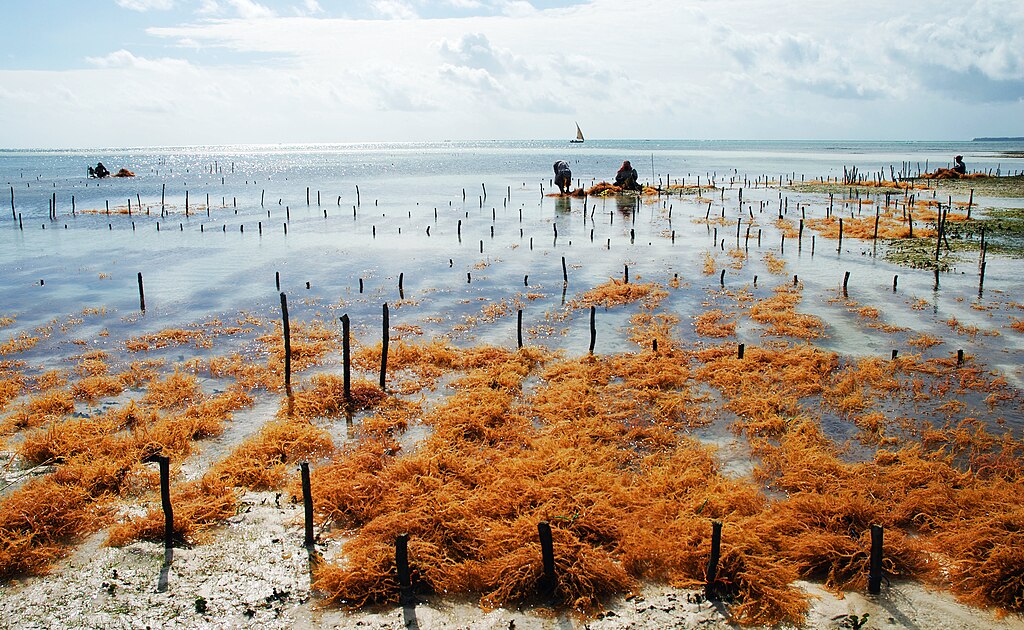
Seaweed farming at Uroa, a fishermen village on Zanzibar’s center-east coast. Photo credit: Moongateclimber, Public domain
Hunger in Africa is not only about food on the table. It is a result of weak systems, wasted harvests, and the price paid for years of neglect. And there are fixes already underway. From compost training in Rwanda to rooftop farms in Cairo, from insurance schemes to hermetic storage bags, Africa’s farmers are showing what can work.
Will leaders and investors keep answering hunger with emergency shipments or will they build on these examples and finally give Africa the tools to feed its people?
Sources
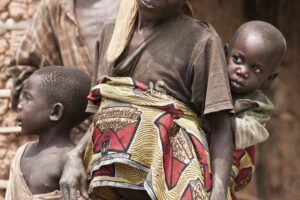
Featured photo credit: Rachel Clara Reed, CC BY-SA 4.0 https://creativecommons.org/licenses/by-sa/4.0, via Wikimedia Commons
FAO, IFAD, UNICEF, WFP, WHO – The State of Food Security and Nutrition in the World 2025 (SOFI)
https://openknowledge.fao.org/items/ea9cebff-306c-49b7-8865-2aef3bfd25e2
UNICEF – Global hunger declines, rises in Africa and Western Asia (2024)
https://data.unicef.org/resources/sofi-2025
FAO – Technical Platform on the Measurement and Reduction of Food Loss and Waste
https://www.fao.org/platform-food-loss-waste/en
World Bank – Post-harvest Loss in Sub-Saharan Africa: What Do Farmers Say?
https://documents1.worldbank.org/curated/en/782981468008454485/pdf/Post-harvest-loss-in-Sub-Saharan-Africa-what-do-farmers-say.pdf
Purdue University – PICS Hermetic Storage Bags
https://www.picsnetwork.org
OCHA – West and Central Africa Floods Situation Report 2024
https://reliefweb.int/report/nigeria/west-and-central-africa-floods-situation-report-2024
OCHA – Flooding in Congo River Basin (DRC)
https://reliefweb.int/report/democratic-republic-congo/drc-flood-situation-report-2024
Kiwanuka, M. – Evaluating Eutrophication and Water Clarity on Lake Victoria (Sustainability, 2025)
https://www.mdpi.com/2071-1050/17/20/9056
Njagi, D. – Human-induced changes and resilience of Lake Victoria (Science of the Total Environment, 2022)
https://www.sciencedirect.com/science/article/pii/S0048969722025189
NLM/PMC – Land use, precipitation, and water quality in Lake Victoria
https://pmc.ncbi.nlm.nih.gov/articles/PMC11511718
CABI – Fall Armyworm Impact in Africa
https://www.cabi.org/news-article/fall-armyworm-continues-to-threaten-food-security/
FAO – Fall Armyworm Portal
https://www.fao.org/fall-armyworm
Economist Intelligence Unit – Africa’s Megacities in 2035
https://www.eiu.com/n/campaigns/africa-2035
Nairobi City County – Urban Agriculture Promotion and Regulation Act (2015)
https://nairobicity.go.ke/acts/urban-agriculture-promotion-and-regulation-act-2015
City of Cape Town – Urban Agriculture Policy
https://resource.capetown.gov.za/documentcentre/Documents/City%20strategies%2c%20plans%20and%20frameworks/Urban_Agriculture_Policy.pdf
Ministry of Food and Agriculture, Ghana – Planting for Food and Jobs Phase II
https://mofa.gov.gh/site/programs/pfj
Ministry of Agriculture, Rwanda – National Agriculture Insurance Scheme
https://www.minagri.gov.rw/insurance-scheme
Kenya Warehouse Receipt System Council
https://www.wrsc.go.ke
IRD – BIO-Kenya Project
https://en.ird.fr/kenya-launches-bio-kenya-project
Tena, W. – Effect of Rhizobium Inoculation on Faba Bean in Ethiopia (Agriculture, 2021)
https://www.mdpi.com/2077-0472/11/1/38
World Bank – Seaweed Farming in Zanzibar
https://www.worldbank.org/en/news/feature/2021/06/21/seaweed-farming-in-zanzibar
UNDP Tanzania – Seaweed Farming Empowers Women
https://www.undp.org/tanzania/stories/seaweed-farming-empowers-women